Whether you operate one service van or a fleet of fifty trucks, your vehicles represent both your biggest asset and your biggest liability. We build commercial auto programs that balance coverage, cost, and compliance — from single-truck owner-operators to multi-state fleet operations.
Commercial auto insurance is required for any vehicle used for business purposes in California. Unlike personal auto policies, commercial auto is designed for the specific risks businesses face — employees driving company vehicles, transporting equipment and materials, hauling cargo, and operating specialized trucks and machinery.
A standard commercial auto policy includes several coverage components:
Liability coverage pays for bodily injury and property damage you cause to others in an at-fault accident. California requires minimum limits of $15,000/$30,000 bodily injury and $5,000 property damage, but these minimums are dangerously low for commercial vehicles. A single serious accident involving a commercial truck can easily generate claims exceeding $1 million. We recommend a minimum of $1,000,000 combined single limit (CSL) for most commercial vehicles.
Physical damage covers your own vehicles. Comprehensive protects against theft, fire, vandalism, weather, and animal strikes. Collision covers damage from accidents regardless of fault. For newer vehicles and financed/leased trucks, physical damage coverage is typically required by the lienholder.
Uninsured/underinsured motorist (UM/UIM) coverage protects you when the other driver doesn't have insurance or doesn't have enough. California law requires insurers to offer UM/UIM up to your liability limits.
Medical payments covers medical expenses for you and your passengers regardless of fault, up to the policy limit.
If your employees ever use rental vehicles or their personal cars for business purposes, you need hired and non-owned auto coverage. This extends your commercial auto liability to cover vehicles you don't own. Without it, a delivery driver using their personal truck for a company errand could expose your business to an uncovered liability claim. This coverage is inexpensive and essential for virtually every contractor.
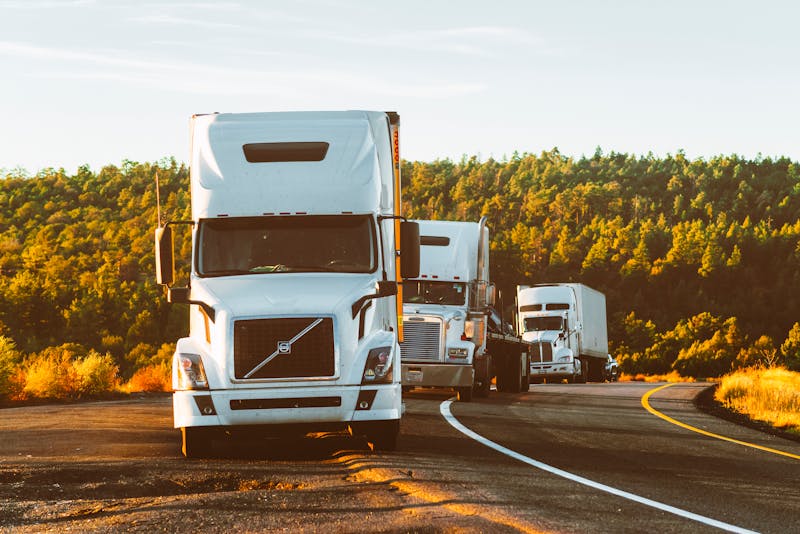
If you operate vehicles over 10,001 lbs GVWR or haul regulated commodities, you enter the world of Federal Motor Carrier Safety Administration (FMCSA) regulation. The requirements are stricter, the premiums are higher, and the consequences of non-compliance can shut down your operation.
For-hire motor carriers must file proof of insurance with the FMCSA. The minimum requirements depend on the type of cargo:
The MCS-90 endorsement is required for all for-hire interstate carriers. This endorsement guarantees that the insurance company will pay any liability judgment against the carrier, even if the policy would otherwise exclude the claim. It's a protection for the public, and carriers factor the additional risk into your premium.
The BMC-91 filing (or BMC-91X for self-insured) is the proof of financial responsibility that gets filed with FMCSA. Without an active filing, your operating authority can be suspended.
California requires a Motor Carrier Permit (MCP) from the DMV for any vehicle operating for-hire with a GVWR over 10,001 lbs. Additionally, the California Public Utilities Commission (CPUC) regulates household goods carriers within the state.
For dump trucks and construction vehicles, California requires specific endorsements for vehicles hauling aggregate, debris, and construction materials on public roads. We structure these programs regularly for our construction clients and know exactly which endorsements each carrier requires.
Commercial auto insurance has become one of the most challenging lines to place in California. Rates have increased dramatically over the past five years due to rising accident severity, nuclear verdicts (jury awards exceeding $10 million), and increased litigation. Managing your fleet program strategically is no longer optional — it's a financial necessity.
Your drivers are your premium. Carriers evaluate your fleet primarily on driver quality — MVR (Motor Vehicle Record) history, years of experience, age, and CDL endorsements. A single driver with a DUI or multiple violations can increase your entire fleet's premium by 20-30%, or make your account unplaceable in the standard market.
We recommend running MVR checks at hire and annually thereafter. California's Employer Pull Notice (EPN) program through the DMV provides automatic notification when a driver's record changes — a critical tool for fleet managers.
Forward-facing dashcams and GPS telematics are no longer luxury add-ons — they're underwriting requirements for many carriers and powerful tools for defending against fraudulent claims. We've seen dashcam footage reduce claim costs by 40-60% by providing clear evidence of what actually happened in an accident.
Many carriers now offer premium credits of 5-15% for fleets that implement approved telematics platforms. The data also helps you identify risky driving behavior — hard braking, speeding, distracted driving — before it results in a claim.
For fleets of 5+ vehicles, we build comprehensive fleet programs that combine liability, physical damage, hired/non-owned, cargo, and trailer interchange into a single coordinated package. Larger fleets may benefit from large-deductible programs, self-insured retentions, or fleet safety groups that pool risk with similar operations for lower rates.
Costs vary by vehicle type, use, and driver history. A single service van might cost $1,500-$3,000/year. A box truck runs $3,000-$6,000. A semi-truck/tractor-trailer typically costs $8,000-$15,000+ per unit. Dump trucks and specialty vehicles can be higher. Fleets of 5+ vehicles often qualify for fleet discounts and bundled programs.
Hired auto covers vehicles you rent or lease for business use. Non-owned auto covers employees using their personal vehicles for business purposes. If an employee runs a work errand in their personal car and causes an accident, your business could be liable. This coverage is inexpensive (often $200-$500/year) and essential for any business whose employees ever drive for work.
The MCS-90 is a federally required endorsement for interstate for-hire carriers. It guarantees that the insurer will pay any liability judgment up to the minimum federal requirement, even if the policy would normally exclude the claim. It's not additional coverage — it's a public protection that makes your policy respond to third-party claims regardless of policy exclusions.
Yes. If you use a personal vehicle for any business purpose — driving to job sites, hauling materials, meeting clients — your personal auto policy likely excludes business use. A commercial auto policy or a business use endorsement on your personal policy is required to avoid a coverage gap. Claims denied for business use of a personal vehicle are extremely common.
Interstate carriers with vehicles over 10,001 lbs GVWR must carry minimum liability limits ($750K-$5M depending on cargo type), file proof of insurance with FMCSA (BMC-91), maintain an MCS-90 endorsement, and keep their Motor Carrier Permit current with the California DMV. Non-compliance can result in suspension of operating authority and vehicle impoundment.
Many carriers offer 5-15% premium credits for approved telematics and dashcam systems. Beyond the direct discount, dashcam footage dramatically reduces claim costs by providing clear evidence in accidents. We've seen footage reduce or eliminate liability on claims that would have otherwise cost $50,000+. The technology pays for itself within the first avoided claim.
Talk to an advisor who actually understands your industry. No call centers, no generic quotes — a real conversation about your business.
Start a conversation