Roofing is the highest-risk construction trade to insure in California. Class codes 5551 and 5552 carry some of the steepest workers' comp rates in the state, liability carriers restrict capacity, and one bad claim can follow your business for years. We specialize in building insurance programs specifically for roofers — because this niche demands a broker who actually understands the exposures.
Roofing contractors face a convergence of underwriting challenges that make insurance both expensive and difficult to obtain. Height exposure is constant and unavoidable. Workers operate on sloped surfaces, near roof edges, and often in extreme heat. The materials — hot asphalt, torches, heavy shingles — add their own hazards. And the completed work itself carries long-tail liability because roof failures may not become apparent for years.
The result: most standard-market insurance carriers either decline roofing contractors outright or impose severe restrictions — exclusions for residential steep-slope work, height limitations, or residential-only endorsements that void coverage if you take a commercial job. Navigating this restricted market requires a broker who knows which carriers genuinely want roofing business and which ones are just collecting premium while looking for reasons to deny claims.
California compounds these challenges. Workers' comp rates for roofing are among the highest in the nation. Cal/OSHA enforces fall protection requirements aggressively — roofing is consistently one of the most-cited industries for fall hazard violations. And California's construction defect litigation environment means your completed operations exposure extends for a decade.
The CSLB requires a C-39 license classification for roofing contractors. This license requires a $25,000 contractor's bond and proof of workers' compensation insurance. Under SB 216, even sole proprietor roofers must now carry workers' comp — no exemptions.
Roofing has two primary workers' comp classification codes in California:
Both codes carry base rates that are among the highest in the California classification system. At current WCIRB advisory rates, roofers can expect base rates in the range of $18-$25 per $100 of payroll — meaning a roofing company with $1 million in annual payroll could pay $180,000-$250,000 in workers' comp premium before any X-Mod adjustment.
Because the dollar amounts are so large, experience modification management is critical for roofers. The difference between a 1.00 X-Mod and a 0.80 X-Mod on a $200,000 base premium is $40,000 per year. Over a three-year experience period, that's $120,000 in savings — enough to fund a robust safety program, invest in fall protection equipment, and still come out ahead.
The claims we see most frequently in roofing workers' comp:
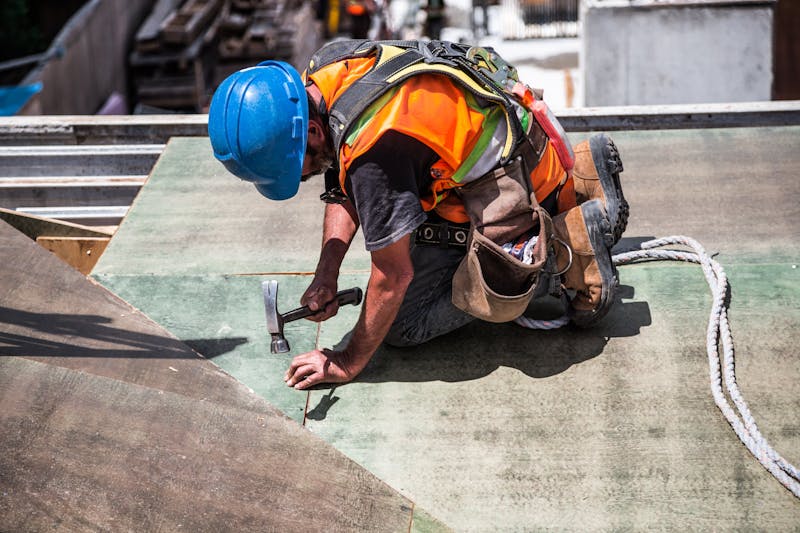
OSHA 29 CFR 1926 Subpart M is the fall protection standard that governs virtually all roofing work. It requires fall protection for any worker exposed to a fall of 6 feet or more — which means every roofing job in existence. The standard allows three methods of fall protection: guardrail systems, safety net systems, and personal fall arrest systems (harnesses).
For roofing specifically, OSHA provides some flexibility. On low-slope roofs (4:12 pitch or less), workers more than 6 feet from the edge may use a warning line system instead of active fall protection. On steep-slope roofs (greater than 4:12), full fall protection is required at all times for any worker within 6 feet of the edge.
California's Cal/OSHA regulations mirror federal OSHA's Subpart M but are enforced independently by the state. Cal/OSHA is generally more aggressive in enforcement and may issue citations where federal OSHA wouldn't. Roofing contractors should be prepared for both scheduled inspections and complaint-driven investigations.
A strong, documented fall protection program does three things for your business: it keeps your employees alive, it satisfies your insurance carrier's safety requirements (some carriers audit your fall protection program as a condition of coverage), and it dramatically reduces the claims that drive your X-Mod up and your profitability down.
We provide every roofing client with a Cal/OSHA-compliant Injury and Illness Prevention Program (IIPP) that includes a comprehensive fall protection section, tailgate safety talk templates, and incident investigation procedures. We also conduct annual policy reviews that include a safety program audit — because the best insurance program in the world doesn't help if your safety practices generate the claims that make you uninsurable.
Workers' comp alone for roofers runs $18-$25 per $100 of payroll under class codes 5551/5552 — among the highest rates in the state. A small roofing company with $300K in payroll might pay $54,000-$75,000 for workers' comp, plus $5,000-$15,000 for GL, and $3,000-$8,000 for commercial auto. Total program costs of $70,000-$100,000+ are common.
Class code 5551 covers general roofing operations (new construction, re-roofing, repair). Class code 5552 covers sheet metal roofing. If you also perform non-roofing work (gutters, siding), those operations may qualify for separate, lower-rated class codes. Proper classification is critical — it's the first thing we audit for new roofing clients.
OSHA 29 CFR 1926 Subpart M requires fall protection at 6 feet for all construction work including roofing. Low-slope roofs allow warning line systems for workers 6+ feet from edges. Steep-slope roofs require full fall protection at all times near edges. Cal/OSHA enforces equivalent standards in California with potentially stricter enforcement.
California requires a C-39 (Roofing) license from the CSLB. This requires passing a trade exam, providing a $25,000 contractor's license bond, and maintaining workers' compensation insurance (no sole proprietor exemptions under SB 216). Operating without a license on contracts over $500 is a misdemeanor.
Roofing combines multiple high-risk factors: constant height exposure, physically demanding work in extreme conditions, use of hot materials and open flames, and long-tail completed operations liability. The claims frequency and severity in roofing are among the highest in construction. Most standard carriers restrict or exclude roofing, forcing contractors into specialty markets with higher rates.
Yes, but your options are more limited and expensive. Contractors with X-Mods above 1.25 typically need specialty or surplus lines carriers. We work with carriers that specialize in high-mod roofing accounts and can build a program while implementing the safety improvements needed to bring your X-Mod down over 2-3 years.
Talk to an advisor who actually understands your industry. No call centers, no generic quotes — a real conversation about your business.
Start a conversation